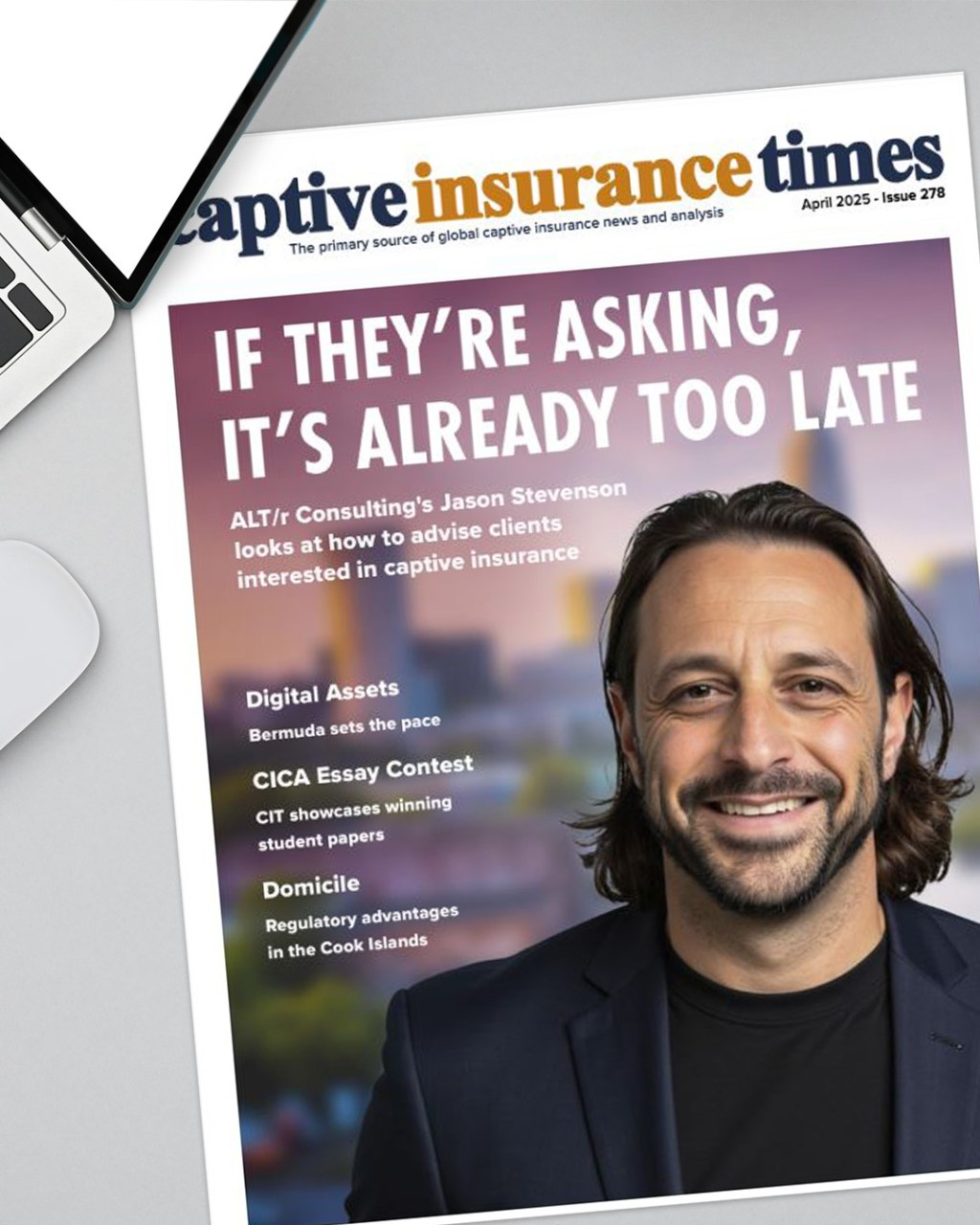
Jason Stevenson, director at ALT/r Consulting, sits down with Karl Loomes to discuss the role of an independent consultancy and how to advise clients interested in captive insurance.
Can you tell us a little about ALT/r and your role as an independent consultant?
As an independent consultant, we work with all the major off-the shelf, group captive product producers. We also work with the independent single-parent captive producers. We do independent consulting relative to captive setup, captive management, captive formation, captive theses and thought processes, as well as feasibility and viability work. We help people assess what exists in the market.
Our role is to support independent agencies and their clients as they think about whether or not a captive is a good idea for them, and if it is a good idea for them, we help them figure out which direction they should go.
There’s no one-size-fits-all element to the captive environment, so our role is really to discern what is right for the client, and we do that through the independent brokerage model. Our unique differentiator is that we distribute what we do through independent agencies, and as far as I am aware, we are among the only ones. We are not a captive manager, so we do not compete in that space. We are a purely consulting division that allows independent agencies to bring in experts where they need them.
There is a big vacuum in the market related to that, because generally, the off-the-shelf product market has done such a good job of monetizing its product and becoming sales organizations that they take up so much space. In many cases, independent agencies do not really know what exists in the market, and important clients only see whatever one of those off-the-shelf product producers has to show today.
What are some of the distinct advantages and disadvantages of off-the-shelf compared to structured captives, and what considerations do you take into account when recommending either to your clients?
Off-the-shelf products have a ton of advantages, in the sense that they are already built. They are a proven machine. They have been tested and worked well.
The downside, or the disadvantage, is just that they are not customised and they are not unique. they do not, in general, provide for the diverse requirements of any particular business that needs or is interested in a captive insurance solution.
Generally, an off-the-shelf product is going to insure three or four lines of coverage. Usually, that is casualty coverage in the US, general liability, auto liability, and workers compensation. I consider that only a partial solution for part of the problem.
There are quite a few other exposures to a business. On the one hand, that may be the majority of a business’s insurance premium spend — and so it seems like it has significant value.
But by contrast, it really is only three or four lines of coverage, and businesses have risk in a wide variety of areas, sometimes insured, sometimes not.
If you look at the other side of captives, which are not off-the-shelf or custom produced — typically single-parent structures — you are able to insure just about anything that is fortuitous and otherwise unpredictable. You can create an insurance vehicle that will insure all those things with a lot more control.
Are there any specific considerations that small and medium-sized enterprises need to be aware of?
Small to medium, obviously, is a function of definition. For a trucking company, for example, small to medium is a totally different thing than say, manufacturers. If you are measuring insurance spend, you have got very different turnover and gross revenue figures, with the same amount of insurance premium or risk. In general, however you define it, small and medium-sized enterprise (SME) insurance was typically reserved for off-the shelf and group products, because there has been a vacuum or limitation in a single-parent environment. In a sense that while single parent structures have always been functionally capable of handling SMEs, the large and largely international brokers and captive managers, have been focused on the Coca Colas of the world; the Premier Leagues; the NFL teams of the world — where you have massive global risk — and therefore you need your own insurance company. In the last decade, single parent captives have ‘migrated downward’, in the sense that they are now relatively far more commonplace for small and medium sized enterprises. This is because of their access to people like me. Their access to information is so much greater, they are not dependent on having just one expert in their region, or one or two in their country, or just one little broker or another to bring them the information. The way that people buy their insurance and the way that people buy their risk management services has changed. It used to be that you would buy your insurance from a guy with a cocktail in one hand and a business card in the other, from your country club or local pub. Today you have convenient online international access. So, information and access to experts have now proliferated, with access to non-off-the-shelf, non-marketed products that did not exist before. This, incidentally, is largely the basis for our business model. We can affect outcomes anywhere.
What would you say are some of the most pressing regulatory compliance and tax considerations facing f irms, and how do you help them navigate these?
I would say, frankly — and especially in an off-the-shelf product environment — there is not a whole lot of regulatory or compliance noise. They are simple, in the sense that they come ‘delivered in a box’. You open the box, and your captive program is effectively ready for you. The majority of the tax, compliance, and regulatory considerations, have already been assumed, paid for, and managed, meaning you get a product ‘ready to roll’.
Continue reading the full article here.
 ALT/r
ALT/r 